The Golden Torch nightclub transformed a quiet residential street in Tunstall into the epicentre of Britain's Northern Soul movement for eighteen months between 1971 and 1973. What began as a modest mod venue in 1965 became, for a brief but explosive period, the most important all-night dance club in the country.
From Cinema to Dance Floor
The building on Hose Street had already lived several lives before the first dancers arrived. Originally constructed as a church, it later served as a roller skating rink before becoming the Little Regent Cinema during the 1940s. When Christopher Burton acquired the property in 1965, he converted it into a mod club with marble pillars, a balcony overlooking the dance floor, and a distinctive Roman chariot mounted on the exterior wall.
The venue opened on 30 January 1965 with Billy J. Kramer and the Dakotas headlining. Throughout the late 1960s, it hosted a mixture of beat groups and emerging soul acts. The Kinks and Wayne Fontana appeared in the mod era, whilst Inez and Charlie Foxx became the first soul act to perform in 1967.
The Northern Soul Era Begins
The transformation into a Northern Soul mecca started gradually. DJ Keith Minshull began running regular Friday soul nights in 1969, and when Manchester's famous Twisted Wheel closed in 1971, Burton saw an opportunity. The Torch launched its first official Northern Soul all-nighter on 11 March 1972, running from 8 pm Saturday to 8 am Sunday.
The timing proved perfect. The Torch inherited the displaced crowds from Manchester and quickly established itself as the leading venue in the scene. By 1972, club membership reached 12,500 with 62,000 separate customer visits recorded that year.
The resident DJ roster included Keith Minshull, Colin Curtis (then aged eighteen), Alan Day, Martyn Ellis, and Peter Stringfellow, who also held a residency at Sheffield's Mojo club. Together they developed the playlist that would define the Northern Soul sound: rare American soul records, often unreleased or forgotten, characterised by uptempo four-four beats and emotional vocals.
Several records received their first British plays at the Torch, including "Sliced Tomatoes" by Just Brothers, "Love You Baby" by Eddie Parker, and "Free For All" by Phillip Mitchell. On 9 December 1972, the club hosted a live performance by Major Lance, which was recorded and later released as "Major Lance Live At The Torch" on the Contempo label.
Live Acts and Legendary Nights
The Torch attracted major American soul artists during its brief heyday. The Drifters, The Stylistics, Oscar Toney Jr, The Chi-Lites, Edwin Starr, Junior Walker, and JJ Barnes all performed at the Hose Street venue. These appearances cemented the club's reputation as a serious destination for both artists and fans.
BBC Radio Stoke's Mary Fox later described the venue as "the Sistine Chapel of this particular faith." Christopher Burton, speaking to Manifesto Magazine, recalled his surprise at the first all-nighter: "I remember turning up at the first one and saying to Keith 'Are these guys for real?' I mean there was no presentation or anything, just a room full of kids dancing to music that I'd never heard of.'"
The Problems of Success
The club's popularity ultimately contributed to its demise. The venue was designed for a maximum capacity of 500 people, yet by 1973 attendances regularly reached 1,300. The building occupied a quiet residential street, and neighbours complained about noise. One resident testified at a licensing hearing that the all-nighters kept his horse awake.
Police attention increased as the crowds grew. Local newspapers ran sensational headlines: "TUNSTALL CLUB A DRUG CENTRE" and "70 PERCENT OF CLUB USERS 'INVOLVED WITH DRUGS'." Regular police presence became a fixture of the weekend events.
On 16 March 1973, Stoke-on-Trent Council refused to renew the club's licence. Burton chose not to appeal the decision. DJ Dave Evison later recalled that the venue "just fizzled out."
Legacy and Influence
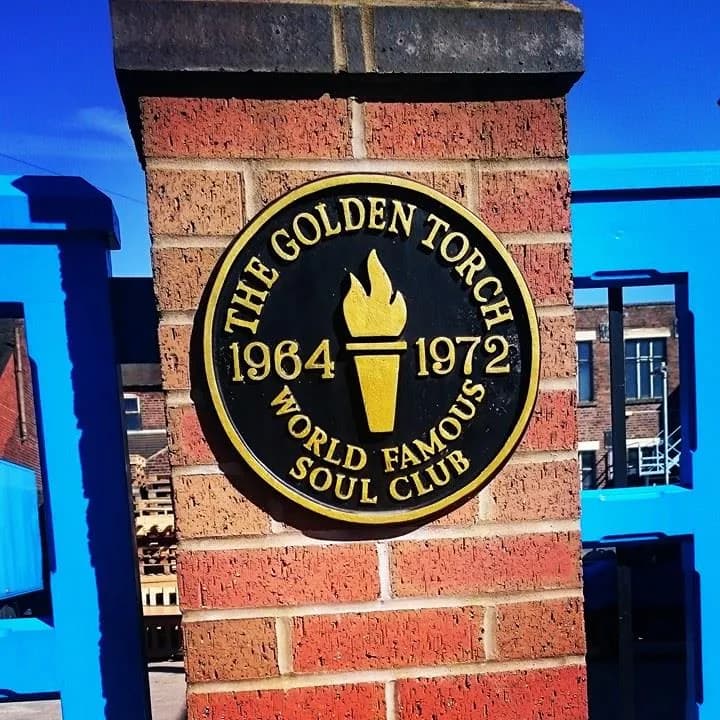
The Torch's closure directly enabled the rise of Wigan Casino, which opened later in 1973 and became the world's most famous Northern Soul venue. The torch logo, depicting a silhouetted hand holding a smoking torch, became a national symbol of the Northern Soul movement and remains recognisable today.
The building itself burned down in a fire after the club closed. In February 2008, a commemorative plaque was erected at the Hose Street site through the efforts of Steve Hoskins and John O'Brien.
Stoke's Place in Music History
The Golden Torch helped establish Stoke-on-Trent, nicknamed "Soul-on-Trent" during this era, as central to British Northern Soul culture. Tunstall, the northernmost of Stoke's Six Towns, hosted a club that briefly eclipsed Manchester and paved the way for Wigan. The venue proved that a small club in a modest street could reshape national music culture, provided the records were right and the dancers kept moving.